


There is nothing wrong with Thai food.
Thai food is excellent. It is fragrant, bright, layered, spicy, sweet, sour, salty, and deeply satisfying. A good bowl of curry or noodles can turn an ordinary day around.
But Thai food is not the entire continent.
Asian food is not just Thai; it is a simple reminder, but it matters. Asian cuisine is not one lane, one flavor profile, or a convenient shorthand for an entire continent. It includes countless regional traditions, ingredients, textures, cooking methods, family recipes, and personal interpretations.
And sometimes, the best way to make that point is not through a long culinary lecture.
Sometimes it is through laundry day and a bowl of noodles.
Restoration Can Begin With Clean Clothes
Laundry day does not usually arrive with a soundtrack.
There is no dramatic reveal. No room service. No one hands you a robe and announces that you have entered your restoration era. There is just a basket of clothes, a washing machine, a few missing socks, and the quiet satisfaction of putting clean things back where they belong.
Still, laundry can be a reset.
Clean clothes create a small sense of order. A quieter room gives the mind less to sort through. Folding something warm from the dryer can feel strangely reassuring, especially when the rest of life has been loud, complicated, or determined to ask for one more thing.
Sometimes the nervous system does not need a breakthrough.
Sometimes it needs clean towels.
There is peace in tending to what is directly in front of you. Wash the clothes. Clear the counter. Open the window. Put on music, or do not. Let the room become a little easier to live in.
That kind of restoration is not flashy, but it is real.


Sunday’s Meal Becomes Thursday’s Joy
Sunday’s roasted pig feet are usually treated as a Sunday delicacy in my kitchen.
They belong to the kind of meal that takes its time. A meal with intention. A meal that may be connected to family, tradition, gathering, or simply the understanding that some foods deserve a little more patience.
But leftovers do not have to remain trapped in their original arrangement.
Today, those roasted pig feet are cut into smaller portions and placed over garlic soba noodles with green onions and mushrooms.
That is the beauty of cooking at home: what is already available can become something new without needing to be reinvented beyond recognition. The roasted pig feet bring richness and depth. The garlic soba brings a soft, savory foundation. Mushrooms add earthiness. Green onions bring freshness and color.
Nothing is trying too hard.
The bowl does not need to look like it belongs beneath a spotlight. It does not need a decorative drizzle, a tiny edible flower, or a caption explaining its worth.
It just needs to be good.
The noodles are glossy and warm. The garlic settles into the sauce. The mushrooms hold onto their tenderness. The green onions add that sharp little lift at the end. The roasted pig feet make the whole thing feel substantial and familiar, while the soba gives it a weekday rhythm.
Then comes the moment when the bowl is ready.
Chopsticks in hand.
A quiet kitchen.
The first bite.
Slurp. Slurp.
Peace has entered the room.
Asian Food Is Not One Thing
Broad labels can be useful when we need a quick way to describe a large category. But they can also flatten the very things that make food meaningful.
“Asian food” can refer to foodways from East Asia, Southeast Asia, South Asia, Central Asia, and West Asia. Even within those regions, there are distinct national, regional, religious, historical, and family traditions.
A noodle dish from Japan is not automatically the same experience as a noodle dish from Vietnam, Malaysia, Korea, China, or the Philippines. Rice can be prepared in countless ways. Spices, sauces, ferments, broths, cooking fats, and textures change from one kitchen to the next.
Even the cuisines we casually name as one thing contain many worlds within them.
Thai food itself is wonderfully diverse. Northern Thai cooking is not identical to southern Thai cooking. Central Thai dishes are not the whole story. Isan food has its own character, ingredients, and traditions. So even “Thai food” deserves more room than a single familiar menu.
The same is true everywhere.
This bowl of garlic soba noodles with roasted pig feet is not trying to represent every Asian kitchen. It is one personal meal, made from what was available, shaped by memory, appetite, and the desire to make an ordinary day feel cared for.
That specificity is part of the joy.
A useful overview from Education About Asia also makes clear that Asian food traditions are shaped by geography, history, migration, religion, trade, and local ingredients. Those influences do not produce one interchangeable cuisine. They produce many connected, distinct, and evolving food cultures.
So yes, enjoy the pad thai.
Order the green curry.
Love the tom yum.
But also make room for the full, untidy, delicious range of what Asian food can mean.
Thai food is excellent. It is not the entire continent.

Choosing Joy Without Asking Permission
There is a particular kind of pressure to make joy look impressive.
The meal must be expensive. The room must be perfectly styled. The experience must be shareable. The destination must be recognizable. The pleasure must be approved by an audience before it can count.
But joy does not always arrive dressed for public inspection.
Sometimes it is a load of clean laundry.
Sometimes it is using the good bowl on a regular weekday.
Sometimes it is taking a Sunday-style delicacy and giving it a new role instead of waiting for the next special occasion.
Sometimes it is eating at home because you want exactly what you want, prepared exactly the way you like it.
No reservation required.
No permission slip.
No need to explain why roasted pig feet belong on garlic soba noodles today.
The meal can simply be yours.
That does not make it less meaningful. It may make it more so. Personal pleasure may be specific. It is allowed to carry history. It can be practical, improvised, and deeply satisfying at the same time.
The world may continue to insist that restoration must involve luxury, travel, or a major breakthrough. Those things can be wonderful, too. But they are not the only doors into peace.
A quiet kitchen is a door.
Clean clothes are a door.
A meal made from what you already have is a door.
The point is not to perform contentment. The point is to notice when contentment is already sitting in front of you.
A Bowl Can Be Enough
The luxury of enough is not about lowering your expectations.
It is about recognizing abundance when it is present in a form that does not announce itself.
Enough can be a stocked kitchen. Enough can be leftovers with potential. Enough can be time to cook slowly, or enough energy to assemble something simple. Enough can be a good appetite after a long day and the freedom to follow it.
There is dignity in making something intentional from what is already available.
There is pleasure in knowing your own tastes.
There is peace in refusing to make every good thing complicated.
Today, the laundry is clean. The room is quieter. The kitchen smells like garlic. The mushrooms are tender. The green onions are bright. The roasted pig feet have found their way into a new meal, and the soba noodles are waiting patiently in the bowl.
That is not a small thing.
That is a life being tended.
And somewhere between the clean clothes and the last noodle, the day becomes softer.
Joy does not need to be exotic, expensive, or explained to strangers. Sometimes it is simply specific, familiar, and well-seasoned.
Slurp. Slurp.
That counts as peace.
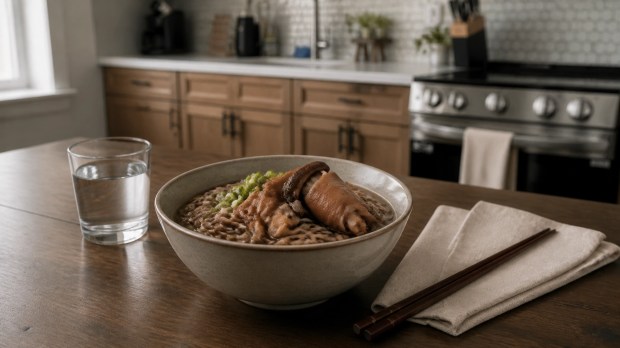
Digital Realism & Aesthetic Direction. Rendered by our team. Orchestrated by Felicia. Section 31, TN Chapter
AI assistedAI-assisted