


SEO Title: Qigong for the Shielded Life — Five Gentle Movements, Seated Options Included
Meta Description: Five accessible qigong movements with seated modifications for stress, balance, and returning to yourself. Presence as protection, one slow breath at a time.
There is a moment between what happens and what we do next.
Sometimes it lasts half a second. Sometimes it is the length of one slow breath. That small space can be the difference between responding with intention and sending a message we will later reread while whispering, “Why did I say all that?”
A shielded life is not a life without stress, interruptions, difficult people, or unexpected news. It is a life with practices that help us return to ourselves before the outside world gets to choose our posture, pace, and reply.
Qigong offers one gentle way to practice that return.
Qigong combines slow movement, focused attention, controlled breathing, and relaxed posture. The National Center for Complementary and Integrative Health describes many forms of qigong as smooth, gentle, and suitable for standing, sitting, or still meditation. It is not a performance, a competition, or another task to complete perfectly. It is a conversation with the body, and the body does not need to shout to be heard.
Research on qigong is promising, particularly around stress, anxiety, sleep, balance, and general well-being, although it is not a replacement for medical or mental health care. A review published in the International Journal of Environmental Research and Public Health describes qigong as a meditative movement practice that may support recovery from sustained activation through slow movement, active relaxation, focused attention, and conscious breathing.
In other words: qigong gives you somewhere to put your attention when your thoughts are trying to open seventeen browser tabs at once.
Presence as protection
Before reacting, pause.
Notice your feet, your seat, your shoulders, and your breath. You do not have to force yourself to feel calm. You only have to become aware of what is already happening.
Maybe your jaw is tight. Maybe your chest feels busy. Maybe your hands are prepared to type a paragraph that begins with “Just to clarify” and ends with a small emotional explosion.
Presence creates room.
That room does not guarantee that every response will be perfect. It simply gives you more choice. You may still say no. You may still set a boundary. You may still leave the conversation. But you are more likely to do so from a grounded place rather than from the first wave of irritation.
Try this before beginning:
- Sit or stand in a way that feels supported.
- Let your shoulders soften.
- Keep your breath natural.
- Notice one physical sensation without judging it.
- Ask, “What needs my attention right now?”
Then begin where you are.
Five qigong movements for a shielded reset
Move slowly enough that you can feel the transition from one position to the next. Nothing needs to be large. If your breathing becomes strained, return to a natural rhythm. If standing is uncomfortable, practice seated. If a movement does not suit your body today, make it smaller, or leave it out.
1. Wuji / Posture of Infinity
Wuji is the quiet starting point.
Stand with your feet comfortably grounded and your knees softly bent. Let your arms rest naturally by your sides. Keep your spine aligned without forcing it into rigid perfection. Imagine the crown of your head lengthening upward while your weight settles downward.
Breathe slowly and comfortably.
The purpose is not to look serene enough for a luxury wellness brochure. The purpose is to notice support. Feel the floor beneath you. Feel the chair beneath you if you are seated. Allow your body to understand that it does not have to brace against every moment.
Seated or modified option: Sit toward the front of a sturdy chair with both feet supported. Let your hands rest on your thighs or by your sides. Keep the spine comfortably upright, or use the back of the chair for support.
Stay for several breaths. This is already practice.


2. Opening and Closing / Commencement
From Wuji, allow your hands to rise slowly as you inhale. They do not need to reach shoulder height. Lift only as far as feels comfortable. As you exhale, lower your hands with the same care.
Think of the movement as opening space and then returning to center.
The breath leads. The arms follow. Let the shoulders remain relaxed instead of creeping toward your ears as though they have received alarming news.
Repeat several times, keeping the pace unhurried.
Seated or modified option: Keep your elbows close to your body and move only your hands or forearms. You can also imagine the rising and lowering motion without moving at all. Visualization and attention are valid parts of a qigong practice.
3. Parting the Clouds
Bring your attention to the space in front of your chest. With an easy inhale, allow your arms to open outward, as if gently parting clouds. Do not push or stretch aggressively. Make room through the breath, the chest, and the imagination.
As you exhale, let the arms return toward the center without collapsing inward.
This movement can become a reminder that space is not something you have to earn from other people. Sometimes you create it by taking one breath before answering. Sometimes you create it by closing the laptop. Sometimes you create it by admitting that a room, routine, or relationship has become too crowded for healing.
Seated or modified option: Open the hands from the center of the chest to a comfortable width. If shoulder movement is limited, move your hands along your thighs or simply turn your palms outward and inward with the breath.
4. Cloud Hands
Cloud Hands introduces gentle circling and weight shifting.
As one hand moves across the body, let the other hand follow in a slow, rounded path. Shift your weight softly from one foot to the other, without leaning or forcing balance. The movement should feel continuous, like clouds drifting rather than a marching band preparing for halftime.
Keep your eyes open if that helps with balance. Let your attention stay with the hands, feet, and breath. When the mind wanders, return to the circle.
This is particularly useful when tension has made everything feel abrupt. Cloud Hands offers a different rhythm: not stop-start, not all-or-nothing, just one small transition flowing into another.
Seated or modified option: Sit with both feet planted. Circle one hand at a time in front of the body while keeping your torso supported. You can also place both hands over your thighs and make very small circles with your palms.
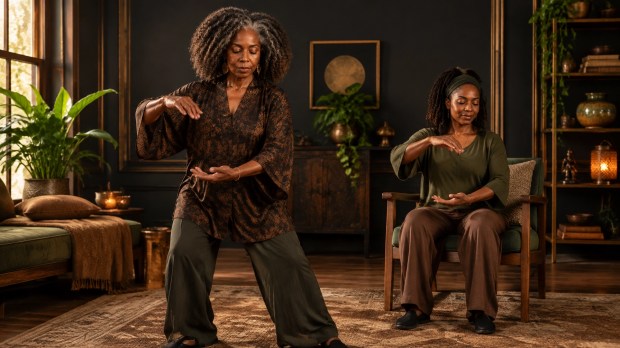
5. Push Hands to Heaven
From a comfortable position, let your hands rise with the inhale. Imagine offering them upward, not straining, reaching, or trying to become a human flagpole. As you exhale, lower the hands slowly.
The rising motion can represent making room for possibility. The lowering motion can represent returning to what is real, present, and manageable.
Repeat at a pace that allows the exhale to feel complete without forcing it.
Seated or modified option: Lift your hands only to chest height, or move just your forearms. If raising the arms is not comfortable, press your palms gently forward and then release them with the exhale. The intention is coordinated breath and attention, not a particular shape.

Protect the conditions that restore you
A qigong reset does not end when the movement ends. The next question is practical:
What keeps disturbing the conditions that help you heal?
Look at the room first. Is there a pile, screen, object, or unfinished task that constantly asks for attention? You do not have to reorganize your entire home in one afternoon. Clear one surface. Put away what belongs elsewhere. Make one small corner easier to inhabit.
Then look at your routines. Are you beginning the day with immediate notifications? Are you saying yes before checking your capacity? Are you treating rest like a reward you receive only after every demand has been satisfied? That arrangement has never been particularly generous.
Next, look at access.
Not everyone needs the same level of access to you. A shielded life may include slower replies, fewer explanations, quiet hours, muted notifications, or a firm decision not to debate your boundaries with people committed to misunderstanding them.
Finally, look at relationships. Some relationships restore you. Some require constant recovery afterward. Some need a clearer boundary. Some need a conversation. Some need distance. Releasing what no longer serves you does not require cruelty. It requires honesty.
Protect what helps you return to yourself.
That may include a quiet practice, a supportive person, a nourishing meal, a good book, or a carefully brewed cup of coffee. For a steady morning ritual, try FB Roasters Uganda coffee, described as a smooth, full-bodied option, or explore the French Roast when your morning needs a little more depth. The point is not to purchase a personality. The point is to make room for rituals that help you meet the day with awareness.
You can also pair your practice with a reflective walk through the Dale’s Angels lifestyle collection, where rest, travel, storytelling, and intentional living belong in the same conversation.
A shield is not a wall
Protection is not isolation.
The shielded life is not about becoming unreachable, emotionless, or permanently unavailable. It is about deciding what deserves entry and what does not. It is about noticing when your body is asking for a pause before your calendar, inbox, or family group chat makes the decision for you.
Qigong can be five movements. It can be one movement. It can be seated breathing while your feet rest on the floor. It can be the choice to wait ten minutes before replying.
Meet your body where it is.
Let the practice be small enough to return to and kind enough to continue. The goal is not to perform peace. The goal is to create a little more space between stimulus and response: and to use that space wisely.
This post was AI-assisted and reviewed for human accountability by Felicia Baxter.