


Thursday: The Pursuit of Peace & Joy
A rut is something that happens to you. A routine is something you build and keep on purpose.
That distinction matters to me because the outside of the day can look exactly the same either way. The washer runs. The clothes finish. Dinner happens. You sit in the same chair and look through the same enclosed porch windows. One version feels like life has narrowed. The other feels like you have created a rhythm sturdy enough to hold you.
The difference is intention.
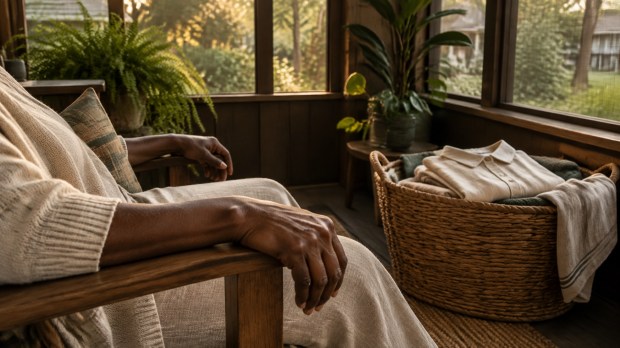
My wash is running, and I am on the enclosed porch, not hovering over the appliance, checking the timer as if the clothes might escape. I let them finish without me. There is something quietly luxurious about leaving a task to complete while I take a real break from it. When I walk back inside, fresh clothes are waiting. The laundry did not need an audience. Neither did I.
That is pleasure as a system rather than an event. It is not a dramatic escape, an expensive reservation, or a perfectly documented morning. It is a cadence I design and protect because I know what happens when I do not. The ordinary becomes one long demand, and eventually even rest starts to feel like another item on the list.
The Porch Is Part of the Routine
I have learned that a break works better when it is actually a break.
That sounds obvious until you notice how often we call something rest while remaining mentally attached to the task we just left. We sit near the laundry room and listen for the machine. We take our coffee beside the laptop. We scroll through our phones while thinking about the email we still need to answer. We are technically seated, but our nervous systems are still standing.
The enclosed porch gives me a different kind of distance. I can sit there while the clothes finish. I can let the air move around me, notice the light changing, and allow ten or twenty minutes to belong to no productive purpose at all. The washer can do its work. I can do mine, which in that moment is nothing more complicated than being present.
Then I return to fresh clothes.
That small sequence has more power than it appears to have. The clothes are clean, the next part of the evening is available, and I have not spent the entire interval supervising a machine. The routine carries me forward without dragging me behind it.

The Bowl Can Be Better
The full bowl is where I allow myself to raise the game.
I am not interested in making a simple meal complicated just because the internet has decided every bowl needs a personality, a backstory, and twelve toppings arranged like a tiny edible parade. Sometimes the noodle is the weak link, and no amount of enthusiasm can turn that into a satisfying dinner.
For my palate, Trader Joe’s and Momofuku noodles are not it. I have tried them, and the frozen, gummy texture lets the whole bowl down for me. That is my personal taste, not a universal verdict on either company or its products. I am simply saying that when I want this particular bowl, those noodles do not give me what I want.
So I keep Top Ramen.
Top Ramen does its job, and it does it consistently. There is no shame in knowing which dependable thing works for you. The upgrade does not have to come from replacing every familiar part. Sometimes you keep the foundation and improve what surrounds it.
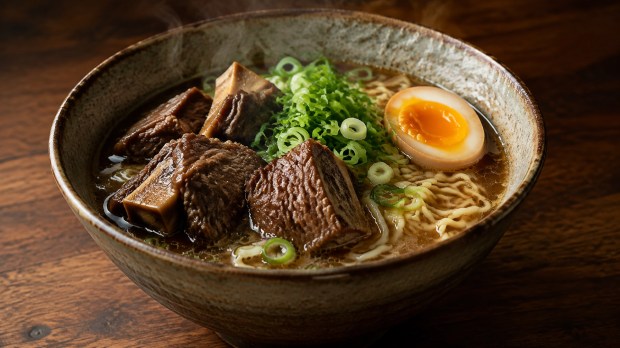
For me, the meaningful upgrade is the beef short rib.
I braise the short ribs low and slow until they fall off the bone. The method is my own: patient cooking, enough time for the meat to become tender, and enough attention to build the deep, savory richness I want. I do not need to invent a complicated sauce or make the broth perform gymnastics. When the short rib is properly tender, the bowl already has a center of gravity.
Then I cut fresh green onions.
That bright, clean lift matters against the richness of the beef and broth. A jammy soft-boiled egg brings its own kind of comfort, but I do not need to keep adding things simply because there is room on top. The rule is easy: toppings have to earn their place.
Nothing gets into the bowl just to look impressive. If a topping adds flavor, texture, or balance, welcome. If it makes me gag, it is not receiving a second chance because someone online called it essential. A topping is either contributing or getting out of the bowl.
Upping your game and overcomplicating the bowl are not the same thing. Two things can be true: I can keep the noodle that works for me, and I can make the meal feel special with a slow-braised short rib. I can enjoy comfort food without treating it like a culinary dare.
The Rhythm Is the Restoration
This is also why I think more about breaks in the ordinary.
Getting away is wonderful. I love a change of scenery, a beautiful room, a long view, and the deep exhale that comes when nobody needs anything from me for a little while. But if we took more real breaks in the ordinary, breaks built into the rhythm instead of postponed until we are completely depleted, we might not need a retreat to rescue us.
The retreat exists because most of us do not get enough of those breaks.
That is the nuance. The ordinary is where peace is supposed to live, but sometimes the ordinary has become too crowded, too demanding, or too far removed from restoration. A retreat is not the cure for a life we need to escape. It is the deep reset that allows the daily rhythm to become sustainable again when the ordinary has not been giving us enough.
That is how I understand Soul of the Valley: not as a replacement for a life, but as a pause substantial enough to help a person return to one. The stillness, guided practices, prepared meals, and mountain setting create room for the reset. Then the work becomes bringing some of that restored attention home: to the porch, the laundry, the kitchen, the ordinary places where a life is actually lived.
Both truths can stand together. We need more breaks in the ordinary. Sometimes we also need the retreat that helps us remember how to take them.
A Cup That Keeps Company
If the bowl is getting an upgrade, the cup can match it without turning the moment into a production.
With a rich braised dish, I would pour something with enough body to keep its place at the table, such as FB Roasters French Roast. The broader FB Roasters coffee collection has plenty of room for choosing according to your own mood, which is exactly how I prefer to choose coffee: with curiosity, not a committee meeting.

No Audience Required
Nobody photographed the bowl.
Nobody rated the laundry.
Nobody watched me sit on the enclosed porch while the clothes finished. No one applauded the short ribs, inspected the green onions, or asked whether the noodles were trending. The fresh clothes were waiting anyway. The full bowl was satisfying anyway. The break was restorative even without proof that it had happened.
That is the part I want to keep.
Fresh clothes, full bowl, no audience. A routine built with enough intention to stay alive, and enough flexibility to let pleasure into it. The rhythm held because I designed it to hold, not because anyone else approved of the design.
The reward is not permission to enjoy the life I have made. The rhythm itself is the reward.
This post was AI-assisted and reviewed for human accountability by Felicia Baxter. Recipe details and personal adaptation were supplied by Felicia Baxter; use your own judgment.