
Sunday, September 6, 2026 : Meditative Rituals
There are days when the mind seems determined to travel everywhere except here.
It replays yesterday’s conversation, edits an old decision, predicts tomorrow’s problem, and then asks the body to remain calm while all of that is happening. The result can be a tightened jaw, raised shoulders, restless hands, shallow breathing, or a face that has quietly become a mask of concentration.
This is where presence becomes protection.
Not armor. Not avoidance. Not pretending that difficult things do not exist. Presence is a way to interrupt the automatic reaction long enough to notice where you are, what you are feeling, and what you need in this particular moment.
The AfroDruid practice of being rooted and shielded begins there: return to the ground beneath you before the world convinces you that you must become something harder, faster, or less human.
“You don’t have to outrun anxiety. You can meet yourself where you are.”
Return instead of rehearsing
Meditation does not require perfect stillness or an empty mind. In fact, the mind may continue producing memories, predictions, judgments, and unfinished lists. The practice is not to win an argument with your thoughts.
The practice is to notice when you have left the present: and return.
Yesterday may offer information, but it does not need to become a courtroom. Tomorrow may require preparation, but it does not need to become a disaster rehearsal. Right now, there is the surface beneath your feet, the chair supporting you, the temperature of the air, and the next breath arriving without needing to be forced.
Breathe before you react.
That single instruction creates a small space between what happens and what you do next. Sometimes that space is barely noticeable. It still counts.
A mindful pause can be as simple as noticing the inhale, feeling the exhale, and allowing your attention to rest on one physical detail. Feel your feet. Notice your hands. Let the shoulders lower by one degree. You are not required to solve your entire life before the next breath.
A small reset for a braced body
Mindful movement gives the body another way to participate in meditation. You do not have to sit cross-legged, touch your toes, or perform a polished sequence. You can work with the body you have today, in the space available to you, at a pace that does not demand a performance.
The purpose is gentle attention.
These small movements may help you notice where you are bracing and reconnect with what is happening now. They are not a medical treatment, and they do not promise instant calm or guaranteed relief. Think of them as invitations: simple ways to give the mind somewhere present to stand and help the body feel safe enough to settle.
Begin seated or standing. Keep your movements comfortable. If anything causes pain, dizziness, or strain, pause and return to a neutral position. Support yourself against a wall or chair if that helps you feel steady.
Soften the mouth
Start with the place where tension often hides in plain sight.
Let the lips rest. Allow the tongue to loosen from the roof of the mouth. Give the jaw a little room. There is no need to force it open or create an exaggerated expression. Simply stop asking the face to hold the entire day.
Unclench the face
Let the space around the eyes soften. Release the brow if it has been gathering weather. Notice the cheeks, the temples, and the forehead.
You do not need to look peaceful. You only need to stop working so hard to look prepared.
Let the shoulders release
Bring attention to the shoulders. Are they moving toward the ears? Are they leaning forward as if expecting impact?
On an exhale, let them drop gently. Do not shove them down. Let gravity participate. Feel the difference between holding yourself upright and holding yourself on guard.
Take one more breath and notice the torso. The movement may be subtle. Subtle is enough.
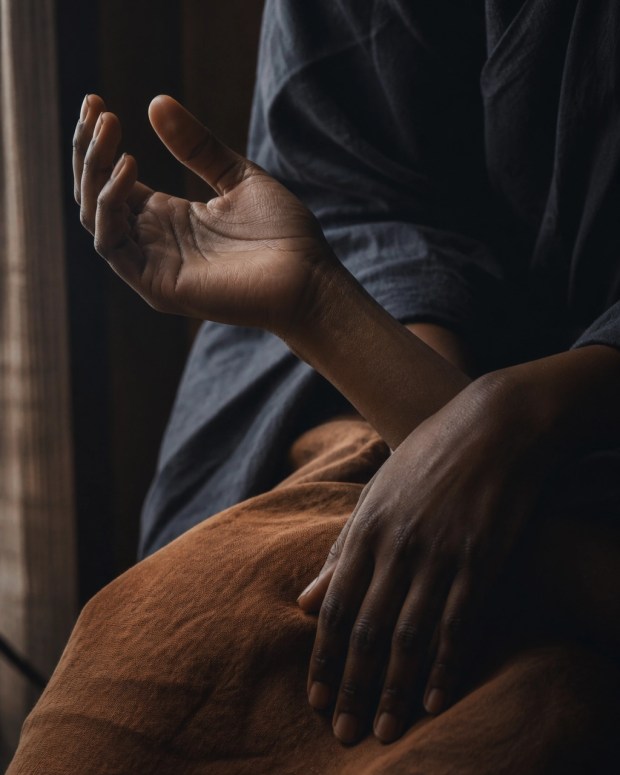
Roll the wrists
Extend the hands comfortably or let them rest in your lap.
Slowly roll one wrist in a small circle. Then reverse the direction. Switch sides. If both wrists move together, keep the motion easy and unforced.
Pay attention to the details: the skin shifting, the fingers changing position, the slight movement through the forearm. Let the wrists be ordinary. They do not need to accomplish anything other than bringing you back to sensation.
If the mind wanders, notice that it wandered. Return to the circle.
This is one of the quiet strengths of mindful movement: the body offers a concrete place for attention to land. You are not arguing with the thought. You are choosing to feel the movement that is happening now.
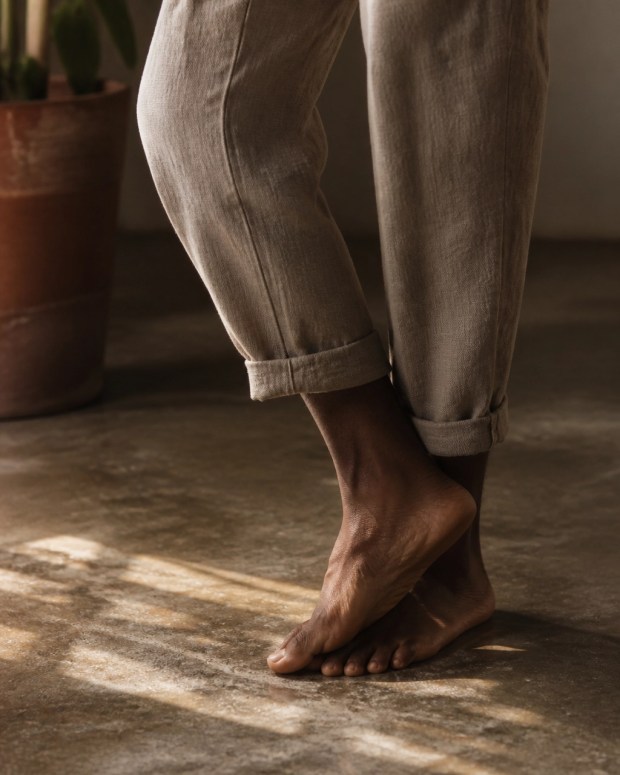
Circle the ankles
If you are seated, place both feet on the floor or extend one leg comfortably. If you are standing, use a wall, counter, or sturdy chair for support.
Lift one foot only as much as feels stable. Slowly circle the ankle in one direction, then the other. Change sides.
Notice the foot’s relationship to the ground. Notice the shift in balance. Notice whether you are gripping with your toes or holding your breath. There is no correct size for the circle. A small rotation is still movement. A pause is still information.
Try a gentle standing stretch
Stand with your feet comfortably apart. Keep your knees soft rather than locked. Let your arms rest by your sides.
On an inhale, reach your arms only as high as feels comfortable. On an exhale, lower them slowly. You can also reach one arm overhead while the opposite side remains relaxed. There is no need to stretch as far as possible.
Notice the sensation of lengthening without chasing intensity. Let the breath remain natural. If your attention moves to comparison: how far someone else can reach, how the movement looks, whether you are doing it correctly: return to the simple feeling of your own body in space.
Mindfulness is not another scoreboard.
Move slowly from side to side
With your feet grounded, shift your weight gently from one side to the other. Keep the movement small enough that you can stay aware of your breathing.
Let the arms hang loose. Let the hips and shoulders respond naturally. You might imagine yourself moving like a tree in a mild breeze: not performing, proving, or forcing: simply responding to what is present.
If standing is not comfortable, try the same side-to-side movement while seated. Let your torso sway a little. Feel the chair beneath you. Keep one hand on your thigh or the center of your body if that provides a useful point of contact.

Presence as protection
Protection is often imagined as something loud: a locked door, a raised shield, a firm refusal. Those forms of protection have their place. But presence offers another kind.
It protects the moment from being completely taken over by an old story or a future fear. It protects your next choice from being made entirely by reflex. It gives you enough awareness to recognize, “I am bracing,” before the bracing becomes the only way you know how to stand.
That does not mean anxiety disappears. It means you have met yourself before the reaction finishes writing the script.
As the body moves, ask quietly:
- What am I noticing right now?
- Where am I holding tension?
- What changes when I stop trying to force a result?
- What would a little more steadiness feel like?
You might not receive a grand answer. You may simply notice warmer hands, a looser jaw, or the contact between your feet and the floor. That is not failure. That is contact with the present.
And sometimes contact is the beginning of enough.
A two-minute return
When you need something brief, try this:
- Sit or stand in a comfortable position.
- Breathe before you react.
- Soften the mouth and unclench the face.
- Let the shoulders release.
- Roll the wrists slowly.
- Circle one ankle, then the other.
- Make a gentle standing stretch or slow side-to-side movement.
- Notice one sound, one physical sensation, and one thing you can see.
- Finish by feeling your feet or the support beneath you.
Move mindfully. Return to yourself.
You do not have to make the practice impressive. You do not have to become perfectly calm. The goal is to offer the mind somewhere present to stand and the body a gentle opportunity to settle.
The future can wait for its turn. The past can remain where it happened.
For now, you are here.
And as the archives remind us: Dystopia for them is Tuesday in the archives. You do not have to let every inherited alarm become today’s atmosphere. Breathe, notice, and meet yourself where you are.
This post was AI-assisted and reviewed for human accountability by Felicia Baxter. Recipe details and personal adaptation were supplied by Felicia Baxter; use your own judgment when handling and reheating leftovers, seafood, and dairy.
