

The Shielded Life
Rooted. Shielded. Undisturbed.
There is a particular kind of clarity that arrives when a crowded room finally has room to breathe.
The floor becomes visible. The light reaches farther. You can walk from one side of the room to the other without navigating a small obstacle course of yesterday’s decisions. Nothing dramatic has happened, but something has shifted. The space feels available again.
Sometimes the same thing happens within us.
We begin to notice how much inherited noise we have been carrying: old expectations, outdated obligations, other people’s fears, unfinished conversations, and possessions we kept long after their season ended. We may call it responsibility. We may call it sentiment. Sometimes it is simply clutter with a compelling backstory.
Walking in purpose requires clarity. It requires enough openness to recognize an opportunity when it appears and enough peace to decide whether that opportunity belongs to us.
That is why decluttering can be more than a household task. It can be preparation.
Sometimes the blessing isn’t missing. Sometimes the room is full.
Decluttering is preparation, not punishment
Decluttering does not have to become another way to criticize yourself.
You do not need a perfect home, an empty calendar, or a carefully labeled storage system before you are allowed to enter your next season. The goal is not to create a showroom. The goal is to make your surroundings more honest, useful, and supportive of the life you are actually living.
A home can be full of meaningful things and still need editing. A mind can be full of good intentions and still need quiet. A schedule can be full of worthy commitments and still leave no room for the work that matters most.
Preparation asks different questions than perfectionism.
Perfectionism asks, “Why haven’t I already handled all of this?”
Preparation asks, “What can I clear today so I can move with greater intention tomorrow?”
That shift matters. It allows us to begin without shame.
Clear the inherited noise
Some clutter did not begin with us.
It may be a belief handed down through family, such as the idea that keeping everything is the same as honoring the past. It may be the pressure to remain available to everyone at all times. It may be a role we accepted years ago because it was necessary then: but no longer fits who we are becoming.
Inherited noise can also be physical. A box of papers, furniture, clothing, or household items may carry a story about who we were expected to be. Holding on can feel like loyalty, even when the item no longer serves a practical or meaningful purpose.
This is where discernment becomes important. Releasing something does not erase the memory attached to it. It does not dishonor the person who gave it to you. It does not mean the past had no value.
It may simply mean the item has completed its assignment.
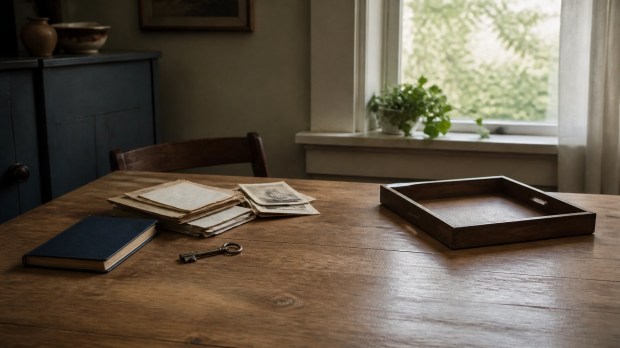
As you sort, pause long enough to ask:
- What am I keeping because it is useful or meaningful?
- What am I keeping because I feel guilty releasing it?
- Which expectations belong to another person’s life, not mine?
- What would become possible if I stopped organizing my present around an expired season?
You do not have to answer every question in one sitting. Awareness is already a form of clearing.
Release what has overstayed its welcome
Not everything that once helped us still belongs with us.
There are clothes that no longer fit our lives, equipment we no longer use, broken items we keep meaning to repair, and gifts we accepted politely but never wanted. There are objects that take up physical space while quietly asking us to remember a version of ourselves we have already outgrown.
Releasing them can be both practical and emotional.
Start with one category or one contained area. A drawer. A shelf. A closet section. One corner of the garage. Empty the space before deciding what returns to it. This gives you a clearer view of what is actually there, rather than making decisions based on piles and assumptions.
Then sort without creating a new maze of indecision:
- Keep what you use, value, or genuinely need.
- Give away what could serve someone else.
- Recycle or discard what is no longer useful or suitable for another person.
- Pause only when the decision truly requires information, not when you are trying to avoid making it.
The point is not to remove everything. The point is to stop allowing everything to claim equal importance.
Make room for movement
A clear space changes how you move through your day.
An open entryway can make leaving the house feel less chaotic. A clear kitchen counter can make meal preparation feel more inviting. A simplified desk can make it easier to begin the work you have been postponing. A calm bedside table can give the end of the day a softer landing.
These changes are small, but small changes can protect our attention.

Think of your home as part of your perimeter. It does not need to impress anyone. It needs to support your ability to rest, think, create, welcome, and leave when it is time to go.
Protect the pathways first. Clear the surfaces you use most. Give frequently used items a reliable home. Make it easier to do the things that align with your purpose and harder for unnecessary disorder to run the day.
A clear path is not merely attractive. It is an invitation to move.
Make room for peace
Physical clutter is not the only kind of clutter that needs attention.
The mind can become crowded with notifications, unfinished tasks, unnecessary arguments, and the constant expectation to respond. We can carry conversations into rooms where they do not belong. We can spend tomorrow’s energy rehearsing yesterday’s disappointment.
Mental decluttering may begin with a simple inventory. Write down everything asking for your attention. Do not organize it immediately. Get it out of your head and onto paper.
Then identify:
- What requires action?
- What requires a decision?
- What requires a boundary?
- What can be released?
Choose one next step instead of trying to solve your entire life before lunch.
You might unsubscribe from messages that no longer serve you. Turn off a few nonessential notifications. Decline one commitment that no longer fits. Set aside ten quiet minutes without filling them with another task.
The purpose is not to escape responsibility. It is to separate responsibility from noise.
A personal step toward physical space
Today, I am making an appointment with Junk King to help clear physical space.
That is a practical decision, not a declaration of perfection. Sometimes the amount of excess has grown beyond what one person can reasonably sort, lift, load, or remove alone. Asking for help can be part of preparation too.
The company’s website includes information about household decluttering, what it takes, and how its process works. Anyone considering a service should review the current details for their location and choose the option that best fits their needs.
For me, the appointment is one concrete action in a larger process: identifying what no longer belongs, clearing a path, and aligning the home with the season ahead.
One action can create momentum.

Protect what belongs in the next season
Making room also means deciding what deserves protection.
Once you have cleared a surface, keep it clear. Once you have created a peaceful corner, resist filling it simply because there is space. Once you have identified a priority, protect time for it before every new request takes its place.
This is where the shielded life becomes practical.
Being shielded does not mean being closed. It means being discerning. It means remaining rooted enough to welcome what is aligned and steady enough to decline what is not. Openness without boundaries becomes exhaustion. Boundaries without openness become isolation. The work is learning how to make room without surrendering the whole house.
Ask yourself:
- What am I making room for now?
- What deserves more attention in this next season?
- Which belongings, commitments, or thought patterns compete with that purpose?
- What boundary would help protect the space I am creating?
- What is one thing I can release before the week is over?
Let the answers guide the next drawer, conversation, donation box, appointment, or decision.
You do not have to clear everything at once. You only have to begin telling the truth about what belongs.
When we make space with intention, we become clearer about what we’re available to receive. Rooted. Shielded. Undisturbed.
This post was AI-assisted and reviewed for human accountability by Felicia Baxter. Recipe details and personal adaptation were supplied by Felicia Baxter; use your own judgment when handling and reheating leftovers, seafood, and dairy.
